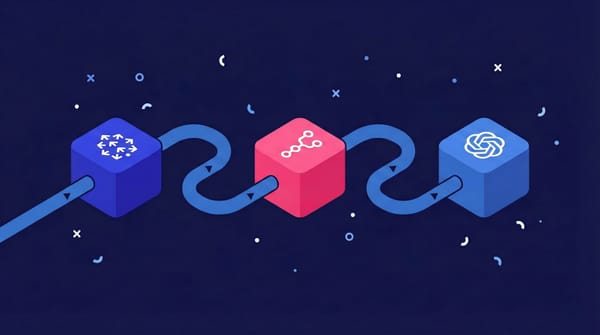
AI marketing automation: From isolated applications to integrated systems


The foundational problem for most marketing teams is a disconnected technology stack. Your CRM, analytics, and ad platforms often operate as independent silos, which forces your team to burn hours on manual analysis, reporting and optimization tasks.
While ChatGPT can help with individual tasks, it often works without critical context. Lacking embedded integration, it simply becomes another silo in your workflow.
To truly leverage AI, you need to think beyond the single instruction. The future is in engineering intelligent, interconnected systems that automate and scale entire marketing functions.
Powered by flexible tools like n8n, automation workflows give marketers the ability to move beyond one-off tasks and build engines that think, connect, and act.
The manual AI trap: Why your ChatGPT prompts don't scale
Using LLM Chatbots like Chat GPT or Gemini for daily tasks is a fantastic starting point. You can brainstorm ideas, technical solutions, write ad copy, or summarize a transcript.
However, standard chat-based LLM interfaces have critical limitations for executing automated, real-world tasks:
- The manual bottleneck: Chat interfaces aren't built for automated bulk data processing. Manually feeding large datasets into a prompt is an inefficient exercise that breaks at scale.
- Context blindness: The AI has no access to your real-time campaign data, your product inventory, or your customer database. It gives you generic advice because it doesn’t know what’s actually happening in your business.
- Operating in a vacuum: The output of a prompt is just text. It doesn't do anything. You still have to take that ad copy, navigate to your ads platform, create a new ad, and paste it in. The insight is disconnected from the action.
The game-changer: From manual prompts to automated engines
The objective is to architect a team of AI agents that execute both routine and complex tasks, freeing up your team and generating actionable insights at scale.
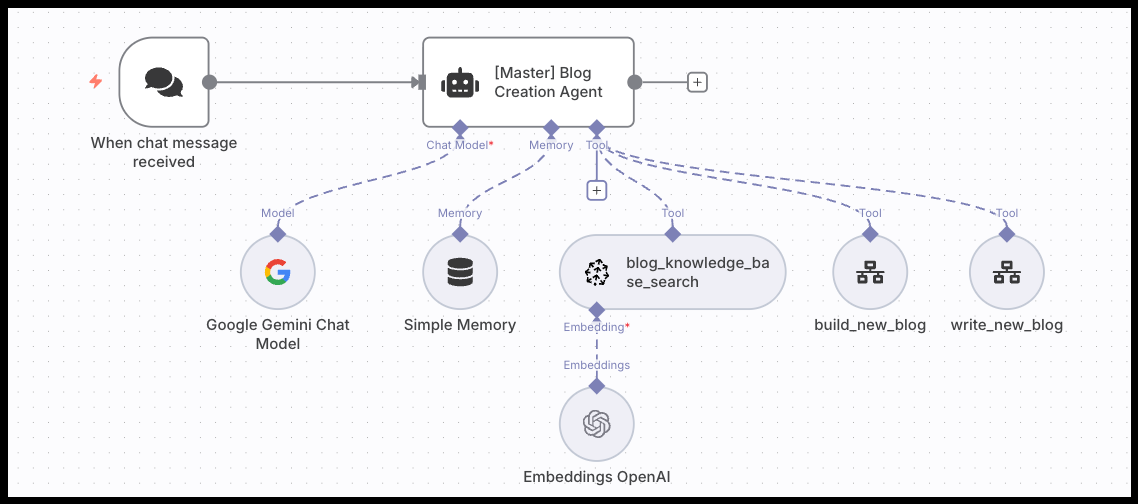
We do this by connecting three distinct layers with an AI workflow automation builder. That’s where a tool like n8n comes in. It’s the platform that allows you to connect these layers without writing (complex) code, creating a seamless engine.
You can find the fundamentals of this software in detail in our guide n8n foundations: a marketers guide to AI Workflow Automation.
Layer 1: The API backbone (connecting your stack)
This is the data layer. APIs (Application Programming Interfaces) are the pipes that allow your (marketing) tools like Google Ads, Facebook Ads, your CRM, Google Analytics, BigQuery, Slack, Google Docs, Gmail, Google Calendar to talk to each other. This backbone gives your system access to the raw materials it needs to work with.
Layer 2: the AI brain (your specialist AI Agent)
This is the intelligence layer. At its heart, the agent's brain is a powerful Large Language Model (LLM). Think of this LLM as a brilliant but general-purpose engine. To perform a specialized task, it needs two key inputs:
- Instruction: This is the direct, specific command you give it, such as "classify the intent of this search term" or "score this new lead."
- Context: This is the crucial background knowledge that makes the instruction meaningful. Using techniques like Retrieval-Augmented Generation (RAG), the agent pulls relevant information from your unique data sources (like product docs, past tickets, or company policies) before it acts. But also a simple Google Sheet with your monthly targets can serve as crucial context an AI-powered system.
By combining your specific instruction with the right context, the LLM is transformed from a generic tool into a specialist AI agent that can execute your business tasks with high accuracy.
Layer 3: The automated action
This is the execution layer. Based on the AI's output, the workflow takes immediate, automated action. If the AI brain scores a lead as "highly qualified," this layer automatically sends a Slack alert to the sales team. If it classifies a search term as irrelevant, it automatically adds it to a negative keyword list in Google Ads.
Building modular & chainable workflows
The real power emerges when you realize these automated engines aren't monolithic systems. They are built from small, specialized, and reusable workflows that can be chained together like LEGOs.
Imagine you build one central, highly-specialized workflow: the AI Data Collection Agent.
Its only job is to take natural language questions (e.g., "What was our cost per lead last week?"), translate them into a perfect SQL queries, execute them against your BigQuery database, and return clean data objects.
This agent is your reusable LEGO block. Now, other simple workflows can call it to perform entirely different jobs:
- The weekly report agent: This workflow runs on a schedule. It calls the AI Data Agent three times with three different questions to get data on spend, CPA, and conversions. It then takes the three clean data outputs and formats them into a summary for a weekly performance email.
- The anomaly detection agent: This workflow runs every hour. It calls the Analyst Agent with one question: "What is the Advertising Spend in Google Ads for the last hour?" It then checks if the result is significnatly above the 12 week average. If so, it sends an urgent alert to a Slack channel.
- The presentation builder agent: This workflow is triggered manually. It calls the AI Data Agent to get performance data for the last 30 days, then uses the structured data to automatically populate a Google Slides presentation template for a monthly business review.
This multi-workflow approach is superior because complex logics (e.g. turning language into SQL) are built and maintained in only one place. The application workflows stay simple, clean, and focused on their specific output.
A modular setup also makes debugging easier and allows for precise, targeted improvements.
Your new role: From marketing operator to systems architect
This shift from prompts to systems requires a corresponding shift in your role as a marketer. Your primary value is no longer in your speed at manually executing specific tasks. Your strategic value is in your ability to design the systems that execute those tasks for you.
You move from pulling the levers to building the machine that pulls them automatically.
This is not about becoming a developer overnight. Tools like n8n are built specifically to empower marketers and operators to connect services and build powerful workflows without writing complex code. Your expertise in marketing strategy is what allows you to identify the right opportunities for automation and to design the logic that makes the system effective.
Explore our full library of n8n workflows and get the copy-and-paste JSON to start automating immediately.